White paper on Mandalah's Medium →
Background
Money will never be an adequate single metric for the value of a business or a product.
There is no replacement metric either; no single metric that assesses the value that something brings to the market, to the people that enabled it, and to the planetary resources that it relies on. The reason is that if we engineered such a metric, it would be more valuable to us than to people or planet.
Financial, Social, and Natural need to carry equal weight. We want positive, compounding returns on all three: we want our investment to deliver positive, compounding returns. We want society to reap positive, compounding benefits, and we want our activities to be fundamentally nature positive — creating mechanisms for life to thrive, and fundamentally leaving the world better than we found it.
Each of the three areas has several indicators that tell us how well we're doing. There is no single metric for each category. In future there might be a useful, weighted score. Right now, we have to be fluid with the metric we look at.
Choosing Your Indicators
Prioritize. In the Digital Economy, for good baselining, choose one metric to represent the cost to nature. We could use water usage, energy usage, mining impact. For now, use carbon footprint, but know that it's not complete. Select it for comparability but more importantly, select it for gravity: select carbon footprint as your leading indicator if you think the CO₂ in the atmosphere is a more pressing question right now for your value chain than the use or misuse of water.
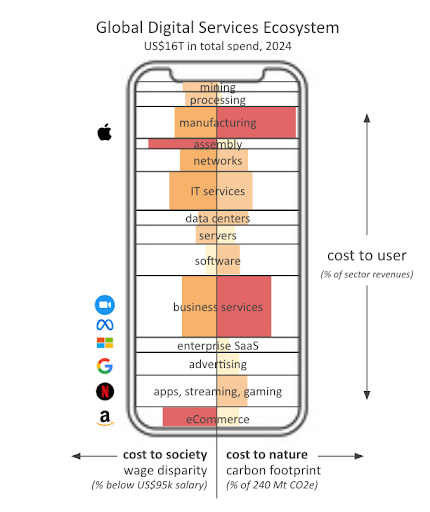
For this particular Digital Economy chart, carbon footprint has been chosen as the leading natural indicator. And for Social impact, find a metric that relates to the extent to which people are being marginalized by the pursuit of wealth and value and productivity of the Digital Ecosystem. You could choose poverty levels, food access, or health impacts, but perhaps the easiest baseline comparison for now is salary multiples: to what extent are the gains of the lucrative Digital Economy fairly distributed among its workers and contributors?
And here we have it. A single map that serves as a starting point when funding a startup in the digital economy. Are you targeting an alpha strategy, or an ecosystem strategy?
This is the "open source" part of the website. Copy it, use it, build on it however you want to.